10 years ago I was working my way through Cathy O’Neill’s excellent Weapons of Math Destruction, the first really loud warning about the inappropiate application of algorithms, and blogging about it. In the book she set out the case against devolving important decisions to mathematical models without adequate feedback loops. Yes, 10 years ago!
I concluded that post by paraphrasing Robert Oppenheimer’s words about the Manhattan Project:
If mathematical models are to be the dominant regulatory tool of a financial world, and of the consultancies and financial firms competing in that world, then the time will come when mankind will curse the names of the highly paid professionals who followed inappropriate rules rather than exercising their own expert judgement when it mattered.
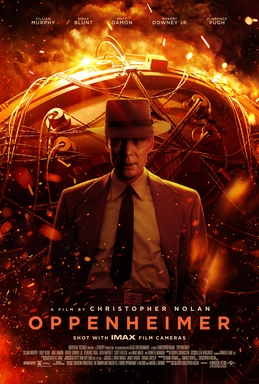
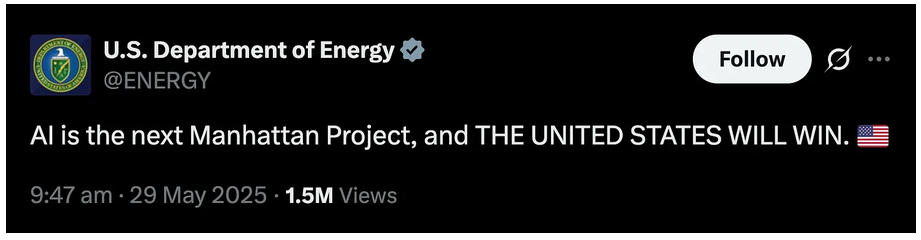
I think that is still a work in progress. Although at least they have made a film about the Manhattan Project in the meantime. And you could say the United States certainly appear to be embracing the analogy:
Meanwhile Cathy O’Neill has done a lot more than just wring her hands about these risks. She has set up her own consultancy (O’Neil Risk Consulting & Algorithmic Auditing or ORCAA) to audit your algorithms for you. As she says:
Whether it’s a hiring algorithm, healthcare AI, predictive scoring system, or generative AI platform, we are here to think about how it could fail, for whom, and what you can do to monitor and mitigate these risks. We are actively developing frameworks and governance approaches to help companies and organizations use algorithms and AI safely – confirming these technologies perform as intended and operate within sensible guardrails. We help our clients realize the transformative benefits of AI, while avoiding discrimination, bias, and other problems.
Their offering includes:
Algorithmic audit, including generative AI, automated decision systems, predictive models, and facial recognition;
Quantitative testing for regulatory compliance;
AI Governance and Risk Management Consultation;
What they call “Cockpit design” – “To make an effective cockpit, you must understand what can go wrong in flight, and include dials/gauges that monitor for those risks. We help build cockpits for your AI systems”; and
Education and Training.
ORCAA have been going for 7 years now, with a range of high profile clients, including AirBnB, Siemens and the City of Amsterdam.
This seems to me a good example of expertise being used in the right way.
A couple of weeks ago I took the IFoA’s AI Manifesto to task for wanting to be on the Red Team rather than the Blue Team, ie the one supposed to be stopping as many AI errors as possible. As I said then:
The Red Team breaks into systems by exploiting a single vulnerability. That is comparatively easy. The Blue Team needs to reassure its clients that it has removed ALL vulnerabilities.
But what if you are not working to protect people from vulnerabilities? What if you are working to protect and accumulate capital instead?
Today I was alerted to the latest article from the IFoA GenAI Working Party, Agent Skills in the Enterprise: Making Actuarial Process Knowledge Reusable. It explains “how an agent skill package can connect reusable instructions with scripts, controlled references, templates, examples and tests”. This will allow organisations to “preserve not only completed models, reports and workpapers, but also the process checks, review decisions and handling of exceptions that produced them using the “agent skill” framework”. As the report puts it:
The problem is not simply that organisations need better prompts. They are preserving the outputs of professional work while leaving much of the procedure that produced them implicit. A completed report records what was concluded. It rarely records every data check, exception, escalation point and review decision needed to reach the conclusion reliably next time.
I can immediately see the motivation. I have been that person trying to replicate a previous valuation result produced by a former colleague I can’t contact, with incomplete data and a-no-longer-supported valuation system which keeps going on the blink. But it was the mention of process knowledge which caught my attention.
I wrote about process knowledge and its importance around a year ago, citing the example of the shrines at Ise Jingu in Japan (which I had learned about from Dan Wang’s Breakneck). This is a now over 1,300 year project to preserve the traditional techniques of building these shrines which involve no nails, just dowels and wood joints. Skills are passed from one generation to the next, there is a tree planting programme which has survived a dozen or more historical eras, pandemics, volcanic eruptions, earthquakes, invasions and oh so many wars over that period. As well as two nuclear bombs.
The important thing is not the ability to build a shrine over 1,300 years later exactly as it was built then of course. It is a proof of concept. It has preserved intricate difficult skills over more than a millenium. And it has involved people, lots and lots of people.
By contrast, the IFoA project has a different, rather shorter term, goal, which is laid out as follows:
This is the first of five articles. The second examines how completed work can become reusable packages. The third introduces SkillOps as the discipline for governing agent skill packages in actuarial work. The fourth considers the consequences for consulting when expertise previously carried through human capital is codified in reusable agent skill packages and becomes intellectual property. The fifth places skills within the wider challenge of continual learning.
It is the fourth article which really bothers me. Once not just the details of a project, but all of the other parts which do not normally get passed on (ie the process knowledge) are captured in this system, it becomes intellectual property, which Cory Doctorow defines as:
any rule, law or policy that allows a company to exert control over its critics, competitors or customers
Up until now, process knowledge has not been given much attention, mainly because it can’t be turned into intellectual property. Process knowledge has always been what remains in the heads of the skilled technicians employed by businesses after everything not nailed down which can be taken ownership of by those businesses has been. Process knowledge has always been the nailed down part. It is the part that has allowed the last vestiges of worker power within most corporations to survive.
Now a group of actuaries think they have come up with a plan to monetize that for the firm as well. To pull up those last remaining nails of worker power.
Think how the IFoA GenAI Working Party would have approached the Ise Jingu shrines.
First you outsource the tree planting programme to a specialist forestry manager. Minimum tender of course: need to get maximum value for money here. Don’t worry about having control over the delivery of timber of just the right type in just the right condition for a unique project. Just leave that to the specialists working on a budget.
Then you sit with the old guys taking you through the various processes involved. Might need some video capture for some of it. Make sure everything they say is captured and then cross-referenced for easier access subsequently. Don’t take too long over it as time is money. Don’t actually feel what it’s like to work with the tools, just note down everything about tool selection. Don’t actually apply the required pressure in the right direction with respect to the grain of the wood, its dryness, the precise cut from the trees selected. Just make sure the video is high enough quality.
I would be surprised if this project survived 20 years. In fact, in view of the fantasy economics of the AI industry, I would be surprised if it lasted even five years if the AI Agents involved in this project relied to any degree on the survival of any of the Magnificent 7.
And this is just to build a shrine out of wood.
These two projects are doing two different things. One is trying to preserve a human activity over a non-trivial period of time. The other is attempting to monetize it so that it can be included in the bottom line for the next quarter. And perhaps to float the idea that your business might be able to dispense with those pesky new employees acquiring process knowledge.
Which brings me to another alarm call. This time from an anonymous group of senior professionals in the UK and European insurance and reinsurance industries called Sounding the Alarm and published in English, French and German. It is not long, so I urge you to read it, but I want to focus on this passage about how the insurance industry is responding to the climate crisis:
Our industry’s strategy is to manage renewals in order to limit our exposure as the physical risk manifests so that premiums are sufficient to cover the rising claims load. This is not a malicious act but a simple response to the commercial realities we are faced with.
We will do this in three ways which many clients are unaware of and governments across Europe are failing to internalise the consequences of:
Firstly, we will reprice our cover. We will simply make policies much more expensive to reflect this elevated physical risk and uncertainty. This will have wider consequences for economic inequality, making it harder for less affluent households to access insurance. It will also increase costs for critical industries such as farming or shipping , creating a significant social and financial burden for government s and, in turn, its taxpayers.
Secondly, we will limit coverage to exclude elevated risks such as wildfires as well as other less predictable risks . The nature of insurance being re – negotiated on a 12 – month basis allows us to do this without friction. Ensuring customers really understand that this is happening is critical.
Thirdly, if there is no way to bring premiums and claims into balance or introduce risk reduction measures we will – for certain geographies and sectors – simply withdraw coverage . This will particularly affect coastal, mountain and flood-prone communities.
This approach is our way of managing our own financial exposure and maintaining profitability at a time of increasing physical risk and increasing uncertainty. Doing so is critical to ensure we can continue to pay claims, therefore fulfilling both our fiduciary duty and our role in society.
This is the flipside of the capitalisation of process knowledge of course. If it can no longer be monetized then ditch it, all the while spouting about “our role in society”. The people on the receiving end will not care whether it is a malicious act or not, it will feel like one.
Both of these stories tell us which side many actuaries are on, and it is the side of capital rather than the side of the people from who it has been extracted. It is not malicious, and it is how many actuaries understand fiduciary duty. To the contract rather than to public interest.
I look back on my own actuarial career. Some time as a scheme actuary where I really felt I was safeguarding the pensions of ordinary people, some time protecting the wealth of already fairly wealthy people from the tax authorities, some time in insurance feeling really quite remote from customers of any kind. And then 10 years helping students into actuarial work. Have I really just been a tool of capital this whole time? Is this why a IFoA sustainability WhatsApp group, which is all about connecting sustainability thought leaders together and raising awareness of the impact of the climate emergency across the finance sector (where I first saw the Sounding the Alarm memo), is so small?
Dan Davies, highlighting Robin Wriggleworth’s new book, A Fabulous Debt: The Epic Story of How Bonds Built the Modern World, wonders whether life insurance actuaries and general insurance actuaries (referred to as casualty actuaries here) have a similar relationship as bond traders and equity traders. It’s a good read. There is even a reference to Craig Turnbull’s magisterial A History of British Actuarial Thought! And this is the conclusion:
Which leads me to the paradox of the title. Reading the histories of actuaries, there seems to be quite a similar needle between the life and non-life insurers; one group place their trust in the higher mathematics, the other deals with heuristics, rules of thumb and vibes. It all comes to a head when you have to draw up the accounts, of course – the big intellectual battle seems to have been the casualty actuaries’ practice of setting reserves depending on the sum of each individual policy, which is really contrary to the spirit of treating risks as draws from a single distribution.
So it makes me think that there is some potential general principle here. Fields of human endeavour where management makes most use of complicated mathematics are likely to be less intrinsically complex and difficult. We use quantitative techniques only when we are content with regarding something as quantifiable.
This feels like a possible explanation. If your acknowledged expertise is in clever mathematics, you are likely to favour techniques which make more things quantifiable and therefore manipulable with clever mathematics. And the more actuaries flood into new fields, the further the quantifying will go.
Capitalism has always been in the business of quantifying things, allocating them to someone (often using considerable violence to do so) and then selling them as property. But late-stage capitalism has a now almost cartoonish obsession with quantifying even things that cannot be easily or successfully quantified, extracting ownership of the thing at the point of quantifying it and then selling it on.
When all the process knowledge has been turned into intellectual property, proprietary knowledge behind paywalls that hide the fact that it doesn’t really work any more, businesses will start to realise that they still have important gaps that are now nearly impossible to fill. There may be a Sounding the Alarm memo about it from anonymous insiders.
We shall not cease from exploration And the end of all our exploring Will be to arrive where we started And know the place for the first time.
T.S. Eliot – Four Quartets
I feel like I am having a bit of a T.S. Eliot week. I have been writing about the OBR since the beginning of this blog in 2013, with their repeated failures as a forecaster forming the banner for the blog for many years.
What has brought me back to the OBR, as if for the first time, is recalling during the recent Funding the Future conference the words of the very good and wise friend of mine who was there with me. I had invited him to talk to one of my undergraduate groups at the University of Leicester during a professional skills session a few years ago. We were looking at past disciplinary cases of the Institute and Faculty of Actuaries and discussing what the actuaries involved could have done better.
In one of the case studies we considered, an actuary had produced a quarterly reserving report for a company, estimating the reserves on a ‘high’ basis of £74.5 million, a ‘low’ basis of £36.9 million and a ‘best’ basis of £52.1 million. The company then produced financial statements for the year, approved by the board of which he was a part, containing a reserve figure of £15.5 million. My friend told the students that the way to challenge in a situation like this is not to focus on the numbers, but instead see that each different number reflects a different story being told. So you need to look at what the story would need to be for the £15.5 million to be an appropriate figure and take issue with the things that don’t make sense within that story.
It was great advice then and still is, and it is definitely the way to look at the OBR I think. We find a story unsatisfactory if the characters are shallow, do not behave in a credible way, and the plot oversimplifies a much richer situation (something which every story must do to some extent to be manageable to the reader) in a deeply unsatisfying way.
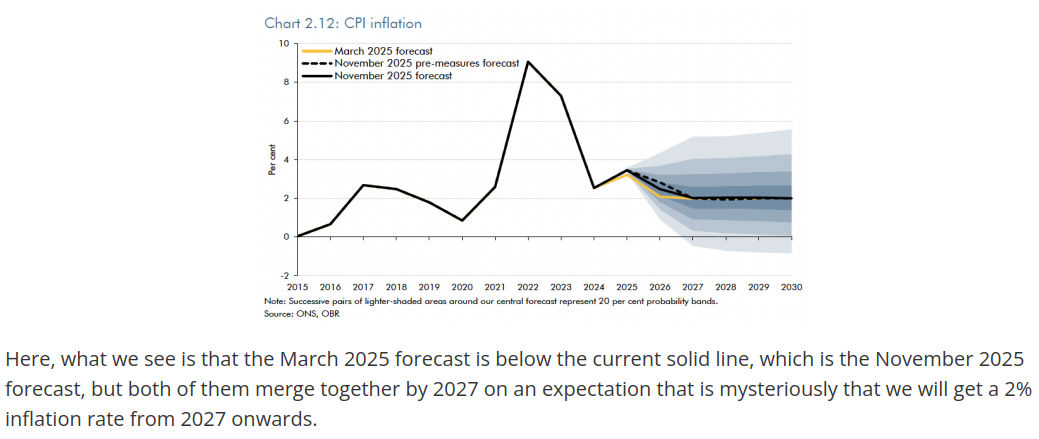
Several other commentators have talked about the inability of the OBR to forecast anything (including me) – this is the equivalent of insufficiently fleshed out characters behaving in unbelievable ways. Richard Murphy, for instance, pointed out how ridiculous the proposed character plotline for inflation was at the last budget:
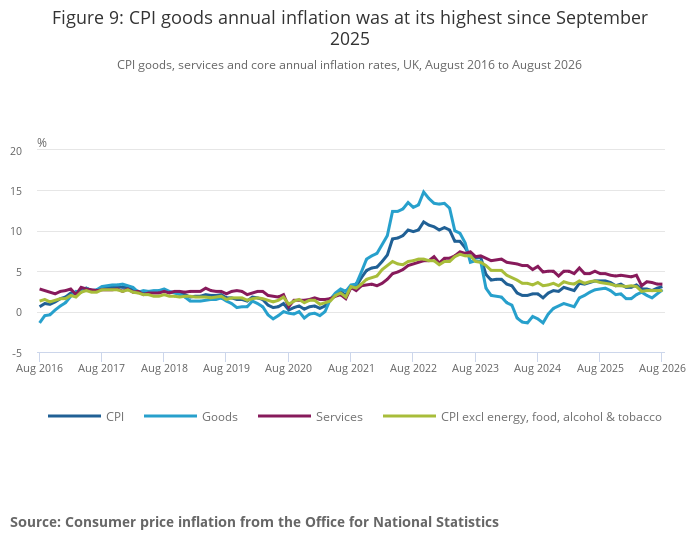
Whereas in fact of course the downward trajectory predicted at the last budget didn’t look remotely likely even then. The Consumer Prices Index (CPI) rose by 3.1% in the 12 months to August 2026, up from 2.9% the previous month.
However it is Dan Davies’ recent couple of Substack posts (one and two) which get to the heart of the problem in my view. Dan Davies’ contention is that it is the plot oversimplification which is the main problem here. As he says:
The system we have set up only seems to be able to communicate two states though – the signal is either “COMPLIANT – WAR CHEST” or “NONCOMPLIANT – BLACK HOLE”. It would be a significant improvement even for the OBR to add some measure of urgency or non-urgency to its press release – a sentence like “this surplus is well within the forecast error, however, so it should not be used to justify a change in policy”.
But, in his view, it is even worse than that:
In general, most things which a government spends money on will tend to have effects on the economy which go well beyond the five year forecast. The OBR uses an information set which contains only a small and quite arbitrary subset of government decisions – it is, literally, not capable of representing the system it is meant to control at an acceptable level of accuracy.
The justification for ignoring the future consequences of current spending seems to be no more sophisticated than what we pejoratively call “Treasury Brain” – the belief that a) spending departments always claim that their budget should be seen as an investment, b) that they systematically overestimate the long term benefits of current costs and c) that the best solution to a) and b) is to completely ignore any future benefits from investment or future costs caused by noninvestment. It’s just not good enough.
It is this dog’s breakfast that apparently tells us whether we are on track to meet the plotline the government has set for itself. Its three fiscal rules:
Rule 1. The current budget should be on course to be in balance or surplus by 2029/30 (‘stability rule’);
Rule 2. Net financial debt should fall as a share of the economy in 2029/30 (‘investment rule’); and
Rule 3. Some types of welfare spending must remain below a pre-specified level (the ‘welfare cap’).
And if that gruesome threesome doesn’t set your heart racing about the country’s future story, you are not alone. Because the people banging on about fiscal space will always push for governments to spend less, regardless of the circumstances. For instance, at the height of the pandemic in December 2020, Moody’s were saying this (with excess deaths already estimated at over 30,000 in the UK by Public Health England at that point):
However, compared to the government’s March budget (that was quickly overtaken by events), there are some initial signs that fiscal policy outside of investment is likely to be less expansive than previously announced. What remains unclear is whether this ambition will be able to withstand the political pressures that seem to be inevitable given the government’s previous commitments. Even before the Spending Review, longer-term spending commitments for health, education, and defence had already been announced. Together, these three areas account for around 60% of total expenditure.
One of the themes from the Funding the Future conference was, to quote from Educating Rita:
“There must be better songs to sing than this”.
I agree. One possibility is proposed by the New Economics Foundation, who suggest categorising policies by their level of multiplier effect (ie how much economic activity is increased by an increase in spending) and replacing fiscal rules with a “fiscal referee” who can make a more holistic judgement addressing many of the omissions Dan Davies complains about. This would then lead to a discussion rather than the compliant/non-compliant cliff edge we currently have, and allow the government to make its case. And it would not automatically incentivise cuts like the current system does.
Other possibilities exist. As Dan Davies describes it:
any accounting system is a mental prison of some kind, and one which needs to be periodically escaped from
Last month the Institute and Faculty of Actuaries (IFoA) launched what it calls its “AI Manifesto“. I thought I would take a look.
The Manifesto is admirably short and to the point. Its pitch can be summarised by this final line of its Introduction and context:
For the benefit of society, we encourage those responsible for developing and deploying AI systems to ensure that there is an actuary in the loop.
Think of it as a massive “Gissa job” plea to those companies currently investing in AI systems. But what sort of jobs are we pleading for?
The idea is that actuaries have been working with models which use machine learning for many years, that we have statistical expertise, are comfortable working with data, used to stress-testing systems and also to looking at the risk appetite of a business as a whole.
I think the first hint that there might be a problem here is when the Manifesto moves onto ethics and the public interest. As it says:
Actuaries help teams balance commercial aims with societal expectations, offering constructive solutions rather than imposing limits.
It is difficult to square this with Anthropic‘s recent IPO filing, where they warn its technology may pose “existential risks to humanity”. I am pretty confident that Society expects not to be put at existential risk. So if Anthropic thinks its technology is that dangerous, there is no balance to be found between commercial aims and societal expectations here. Societal expectations are paramount. And limits will need to be imposed rather than “constructive solutions”.
But, in my view, the main problem here is what “real world” the IFoA feel they are serving. This comes through in the role for “professionalism” they envisage:
Projects with sound validation, honest documentation and clear accountability clear governance more quickly, avoid late-stage rework, and fail in testing rather than in production. Professionalism is what lets an organisation say “yes” to AI with confidence – and protects it from the adverse outcomes that would otherwise force it to say “no”.
This, remember, is in an environment where the latest large language models like Anthropic’s Claude Opus 5.5 or OpenAI’s GPT-6 Astra, are proprietary models where validation, documentation, accountability and governance are all just what they let you see. A framework which allows companies to say yes with misplaced confidence is unlikely to be serving the public interest. And translating a capacity to apply a regulatory model to an insurance company where you have all the data and can make informed judgements about the things that you don’t know (Actuaries are used to working with large, imperfect, transactional datasets subject to audit and regulatory scrutiny. We clarify what data is needed, what quality level is acceptable, and how data should be checked, reconciled and monitored over time) is emphatically not the same as working with a model where you don’t know precisely how it works, cannot accurately predict the errors it will make and do not have enough time to look in all of the places you need to.
Take bias for instance. The Manifesto says:
We examine how a model behaves for different groups and sub-groups, test whether training data is representative of the people the system will affect, and help manage the biases we find responsibly through fairness metrics for predictive models, and output audits and red-teaming for generative systems.
Nita Farahany in the law and policy course documented in her Thinking Freely Substack demonstrates the limits of that bias management in practice, and this is Cory Doctorow on red-teaming (from Red Team Blues):
That’s the problem with blue teaming it—you need to be perfect, while—The red team only has to find a single error
Yes, that’s right, the IFoA haven’t even understood that they are on the Blue Team when it comes to AI errors, ie the one supposed to be stopping as many of them as possible. The Red Team breaks into systems by exploiting a single vulnerability. That is comparatively easy. The Blue Team needs to reassure its clients that it has removed ALL vulnerabilities.
That will be the role of any “actuary in the loop”. And the chances are it won’t be possible. The three examples given by the IFoA are as follows:
A generative AI customer assistant An insurer wants an LLM-based assistant to answer customer queries. An actuary designs the evaluation framework: a curated test set of realistic queries, explicit tolerances for error, escalation rules for high-stakes topics, and live monitoring of answer quality. The project clears internal governance at the first attempt because approvers can see exactly what “good enough” means and how it is evidenced.
A machine-learning decision model A lender deploys an ML model to score applications. An actuary tests behaviour across customer sub-groups, identifies a data artefact that disadvantages one segment, and works with the data science team to correct it. The documentation of that judgement becomes the centrepiece of a constructive conversation with the regulator.
AI risk across an organisation A Chief Risk Officer faces AI adoption in a dozen business units at once. An actuary helps articulate an enterprise AI risk appetite, maps where the organisation depends on the same foundation models, and builds board reporting that distinguishes experimentation from deployment. The organisation accelerates adoption in low-risk areas precisely because it now knows where the high-risk areas are.
None of these examples look unreasonable in isolation, but, to justify the eye-watering expense of this technology, it will need to increase speed and capacity significantly. So, rather than a single generative AI customer assistant, imagine a client relationship management role where a junior actuary or senior student manages 10 times the current expected number of clients at the same time, because the generative AI customer assistant makes that possible?
Will the skills of an actuary versed in the intricacies of Solvency 2 or pensions regulation be so revered by your client that you would be given more than enough time to rubber stamp a system serving 30 or 40 clients? How long do you think you’d need to check the output on all of them properly? I think it unlikely you will be given that long.
This is the risk of becoming a reverse centaur, where you work for the assistant rather than the other way around. And my view is that the actuarial education system is positively encouraging the development of reverse centaurs amongst our current students.
It gets worse. The early evidence suggests that working with AI systems encourages rubber stamping. In one study of AI-generated audits with an auditor in the loop, 150 of the 160 reports were submitted without any changes made by the human. The performance of humans in the loop may also be adversely affected by working with AI systems, leading to “agency decay”:
Agency decay is the gradual erosion of a person’s ability and willingness to observe carefully, think independently, choose deliberately, and act responsibly. It does not arise because AI is inherently harmful. It arises when convenience becomes the default setting for cognition. A tool that first helps us think can begin to think around us, then for us, then without us noticing what has been weakened.
There are lessons to be learned from other professions who have been working for much longer with expert systems. The aviation industry for example. As Craig Bright, Co-Chief Operating Officer at Barclays has posted:
So the test shouldn’t be whether a human appears somewhere on the process map.
It’s whether the system remains understandable, controllable and recoverable when the agent is wrong, uncertain or unavailable.
Safety doesn’t come from leaving a human in the loop.
It comes from designing a system the human can still control.
The IFoA’s position appears contradictory. On the one hand, they clearly don’t believe that AI is as powerful or as dangerous as Anthropic are claiming in order to push up the IPO share price, or I assume they would not be pushing so hard to get an actuary on every team “developing and deploying AI systems”. I think they are right not to believe it, for a number of reasons, but Naomi Alderman’s AI predictions: seven ways you can tell useful thinking from sci-fi fantasies gives probably the most entertaining ones.
On the other hand, if this is just another technology for which the price is going to need to adjust to reality at some point, we need to be very careful as a profession not to be part of the mob urging their clients to adopt it at a faster rate than they would otherwise. Particularly if it is damaging our own professionals in the process.
AI in some form will survive the inevitable crash, but the shape and scope of the wreckage that will be left behind is currently hard to predict. Let’s be careful what we wish for.
This review originally appeared in the September issue of Brum Group News, the newsletter of the Birmingham Science Fiction Group and is reproduced here (lightly edited) by kind permission
I am a big Cory Doctorow fan and have read over half of both his novels and short story collections, in addition to his non-fiction, but would be the first to admit that nerdy teenagers, very keen on computers, distant from their parents and pitched against the authorities, while surrounded by other cooler activists (usually female and pined after by said nerdy teenagers) are very preponderant amongst his protagonists, from Pirate Cinema, to the Little Brother trilogy, to Walkaway and The Lost Cause.
So when a new series of novels started about a 67-year-old forensic accountant called Martin Hench, I was immediately extremely interested. The first, Red Team Blues, came out in 2024 and was a finalist for the Locus Award for best SF novel. This introduced Hench as looking to retire but agreeing to do one last big job for a friend before he does, which obviously turns out to be considerably more difficult and dangerous than it first appeared, even for someone like Marty who is financially secure, and who lives out of a motor home and moves area very regularly. The main idea in the book is that it is much easier to be on the Red Team, ie the one trying to break through the electronic and cyber defences of an organisation, as you only have to succeed once. The Blue Team defending against your attacks have a much tougher time, as they have to succeed every time.
From Red Team Blues, we follow Hench into The Bezzle, a disturbing novel revolving around the corruption and financial exploitation built in to the US prison system, after a friend of his ends up inside on trumped up charges.
The third novel in the series, Picks and Shovels, came out last year, around the same time as Enshittification, and received far less publicity, which is perhaps not entirely surprising but still a shame. This is in many ways a companion piece in showing us that enshittification was always there as an option from the earliest computer days. In it Doctorow takes us back to the early years of the personal computer, and a 20-year-old Marty, big Dead Kennedys fan and accountant, first working out how to make spreadsheets on Visicalc. Which led him into process engineering, then trying to leave process engineering, then getting hit by a noncompete clause in his contract that means they can’t work on computers for anyone else for three years. Which leads to him moving to California where noncompete agreements are illegal.
Doctorow then introduces us to Fidelity Computing, a company which operates like Apple: they make the computers, operating system and all the hardware and software to go with them, none of which work with any other computer. “The Reverend Sirs” who owned the company comprised a Catholic priest, a Mormon bishop and an Orthodox rabbi and they sold via word of mouth in their religious groups spread by their reps on commission. And then three of their female employees, only one of who is in fact a nun, left them and formed a company called Computing Freedom (CF) which sold all of the same peripherals at considerably lower prices. The two companies are now locked in legal disputes and Fidelity ask Marty to make sense of the boxes of floppy discs that CF have sent them under discovery.
What Marty find is that the floppy discs Fidelity makes for their computers are damaged in a very specific way, and that the first thing that a Fidelity computer does on start up is check that the disc is damaged. If it is not, it refuses to run it. He discovers that they make printers with a sprocket spacing that does not match anything found on the market other then their own computer paper.
Marty goes to meet the three women behind CF: they are in the business of trying to jailbreak Fidelity’s customers from the high prices the Reverend Sirs charge. It involves kits to replace the sprocket mechanisms on their printers, dongles that undoes the swap of the first and last byte that a board on Fidelity printers produces. And so on. Marty quickly realises he is on the wrong side.
Things turn nasty when CF tries to compete Fidelity out of business. One of the women ends up in hospital and all of them are threatened with violence. CF don’t have the financial resources to put Fidelity out of business, but the rest of the market does. As Doctorow puts it:
The Dead Kennedys broke up in 1986. That same year, Microsoft went public. It was the starter pistol for a new race whose finish line was the West Coast tech scene.
This is also the creation myth of Martin Hench. He now understood who he is:
I never made the mistake of actually joining a company again. From then on, I stopped pretending I was a finance guy and stuck strictly to being the anti-finance guy – the guy you called when you wanted to catch the finance guy red-handed.
I am looking forward to many more episodes to come!
Last week I suggested that the period of disruption we have entered would be likely to impact the relationship between society and its institutions and professions, and likened those institutions and professions to the models behind the models we normally focus on. I suggested that this has serious implications for actuarial education, amongst much else.
This week I want to expand a little on what I meant by that.
First, the impact of AI. My view of AI is that I don’t believe most of the claims coming out of OpenAI and Anthropic when noone else gets to see the data and they clearly have a vested interest in playing up the capabilities of their systems. And I certainly don’t believe the fantasy economics the Magnificent 7 are currently indulging in is sustainable (see Ed Zitron’s Hater’s Guide to Circular Financing for more on this). But I do believe that there is a lot of political power with an increasingly out of control stake in it continuing, which makes the quote often attributed to Keynes (“Markets can remain irrational longer than you can remain solvent”, although it may have been A. Garry Shilling in 1999) even more relevant here.
However, what cannot be denied is that the existence of AI is accelerating conversations which we should have been having a long time ago. Last month, MIT issued a report called AI and Education, which turns out to be more a philosophical musing about what we should be trying to achieve in universities, and what expectations we should have of both staff and students. It’s not a long report, but for the time poor amongst you there are two passages from this that I’d like to highlight here.
First, on the expectations we should have of students:
Leaning into learning means creating a new “social contract” between teachers and students. All of us who teach at MIT will need to be prepared to help students understand both that the process of education is necessarily a productive struggle, and that the most important product of their education is not a GPA or a diploma but themselves: their personal growth and intellectual maturity and the development of their own imagination, insight, and judgment.
Instilling these attitudes needs to become a central task for every educator, so that our students know not only what they should learn, but also how they should learn and why learning matters. We need to help them develop metacognitive abilities to think about thinking, to engage in reflective practices, and to enhance their sense of personal agency. This will require both dedication and fresh preparation on the part of instructors.
Remember that social contract idea, because it will be coming up again.
Second, on what kinds of assessments we need to move to in anything we still want to be able to refer to as education:
Rather than simply “AI-proof” current methods of assessment, instructors need to revisit what they really want students to know and devise assessments that foster, or even include, the kind of productive struggle that builds durable understanding and mastery.
We urge instructors to consider forms of assessment that are less vulnerable to AI, and more valuable for learning, such as oral exams, semester portfolios, and out-of-class assignments paired with in-class conversations. This likely means resources such as TAs and class time will become more central to evaluation.
and this:
To match the shift towards assessment methods that aren’t vulnerable to AI, instructors need to increase the role of experiential and project-based learning. To encourage this kind of creative teaching, MIT should support the development of teaching skills and practices for all instructors, and recognize contributions in this domain.
As someone who has already spent some time advocating just such a move in higher education, I feel quite vindicated. But back to that social contract point. I am in a WhatsApp group called Actuarial Change in Education (A C E), where we have been discussing this point for a while, but couldn’t agree what to call it. Culture was one proposal, but I think we all agreed on the MIT point that it should be aiming to ensure:
our students know not only what they should learn, but also how they should learn and why learning matters
One kind of school is about culture, compliance and community. We indoctrinate kids, for better or worse, in what it means to be in this world we’ve built, and how to do it together. We teach them how to be kids, how to be citizens and hopefully, how to be adults.
And the other kind of school is about the content. All the ‘R’s. The software that goes with the operating system we taught in the other school.
The first paragraph is what MIT and my WhatsApp group are referring to. It is the bit which has been assumed we shared in common for too long, but is the most important bit. A shared culture or social contract would allow us to meet and discuss things within a shared set of assumptions about how we can get agreement and take action. It is what has been holding back COPs and peace talks and politics more generally for my whole lifetime. It is also how we decide what we put in the second paragraph, which is necessarily stuff which will be being tweaked constantly and be much more short-term in focus..
The second paragraph is what the Institute and Faculty of Actuaries respond with when you ask them about education (I am only picking on them as this is the one I am most familiar with). Curriculum. Syllabus items. Suggested number of hours study. Past papers to practise for the traditional written exam.
Seth Godin calls this software. It is content. It is largely ephemeral, as the needs of the model we operate in and the tools we are given to do so change all the time. Little of it will survive a decade let alone a career. It does not encourage looking up and wondering if there is a better way. It is full of short-term deadlines and urgency and immediacy. Which tends to get confused with importance.
But the software will never surprise you or deal with situations noone has ever met before. If it is not in the underlying model, it will not turn up in the software. The important education is in the operating system. That is what needs to be reformed.
As I said, there is a WhatsApp group discussing such questions regularly. We are a small group currently, but would welcome new members interested in these questions. If you are, then respond to me in the comments section below or via a LinkedIn message if you are reading it there.
A little more information about A C E is set out below:
What is A C E?
Actuarial Change in Education. A place to discuss where change is needed in how actuarial students learn and the changing landscape they are preparing themselves for. A place to argue about how we teach, and how we get students to care about why they are in education and question the assumptions underlying it. A place to share thoughts and ideas you have had or seen about education, actuarial or otherwise. A place to collaborate with others equally concerned about the future of actuarial education. A place to plan and deliver communications with the wider actuarial community.
What are A C E’s aims?
To have an impact on actuarial education by providing a place for developing actionable ideas about education more generally and how they can be applied to actuarial studies in particular. The hope is that these will then be a useful resource for when the need for alternatives gains a wider acceptance.
Who can join A C E?
Anyone interested in the development of actuarial students.
My photograph of an exhibit at the Vatican Museums
Worldbuilding in science fiction has certain rules, or so I thought. And the first of these according to some sources at least seems to be consistency. According to the Quirkworthy website:
The basic message is very simple: your world must be internally consistent. Doesn’t matter if it’s science fiction or fantasy, and it makes no odds if it’s a novel, game, or opera. At all times, your world must be consistent to itself.
So when Jeff Noon and Steve Beard came to the Birmingham Science Fiction Group a couple of years ago, I pricked up my ears when one of them (Jeff I think) said that the first book of the Ludwich Chronicles, Gogmagog, which they were discussing, was not consistent. They were following Cady Meade’s viewpoint which journeyed 60 miles along the river Nysis inside a ghost and the focus was to set a particular mood. It was built from the bottom up.
This idea appealed to me then, and has, in my view, become a more and more important idea recently. We all build our views of the world from the bottom up based on our own experiences and they are frequently inconsistent with those of other people. The problem comes when we stop accepting that and treat our models as, in some way, top down and universal.
I had a great example of this a few years ago in the Vatican Museums. Some bits of bronze they reckoned to be parts of a cart buried in an Etruscan tomb had been discovered and were then displayed on an entirely speculative wooden model of a cart (to be fair to them, the Monteleone chariot dated to around 530 BC, was a rather more complete find and the wooden model looks like it was modelled on that). The trouble is, once you have seen the pieces on the cart, it is difficult to think of them in any other way. Rather like some of those early dinosaur reconstructions and possibly unhelpful in a field as fast-moving as archaeology.
Source: The book of the great sea-dragons, Ichthyosauri and Plesiosauri, [gedolim taninim] gedolim taninim, of Moses. Extinct monsters of the ancient earth. With thirty plates, copied from skeletons in the author’s collection of fossil organic remains, (deposited in the British museum.)by Hawkins, Thomas, 1810-1889 https://archive.org/details/bookgreatseadra00hawk/page/n5/mode/2up
We do this everywhere. Every competitive market is a model, as relentless in its pursuit of victory within the rules (all of which must be stress-tested as to how they are going to be applied by each individual referee in each individual encounter) as the Premier League. Sometimes if you question some of the underlying assumptions behind some of these models, you are told that is just the way the world works.
But the way the world works is opaque. Novelists have attempted to show us glimpses of it for centuries. Historians are sometimes able to agree about how it has worked in a specific geography for a short period of time. Occasionally, as a result of our own experiences, we may feel that we have managed to grasp some truth about the world and how it works in our own lives. But often the clarity slips through our fingers when we throw more light on it. The clarity certainly never seems to last that long. For clarity you often need an organisation signed up to a model.
Much has been written in recent years about our dependence on models and our inability to look outside them in many cases, most notably Escape from Model Land by Erica Thompson. This has mainly focused on the models we make to try and understand the world. But there also models behind those models which effectively determine what kinds of models of the first kind we create. These are the organisations and institutions we look at the world from.
It was in a time of rapid transition and uncertainty much as our own is that the groups of organisations we call professions emerged in the nineteenth century. The model of the second kind they adopted was partly that set out by Daniel and Richard Susskind in their book The Future of the Professions.
According to the Susskinds, there is a Grand Bargain between society and the professions, which means (and I am paraphrasing a little here), in return for professions providing:
Expertise, experience and judgement;
Delivered affordably, accessibly, reassuringly and reliably;
With knowledge and methods maintained and kept up to date, members trained, standards and quality of work enforced and only appropriately qualified individuals allowed in;
Acting honestly and in good faith; and
Putting clients’ interests ahead of their own.
In return, society will give the professions:
Respect and status;
Exclusive rights to perform/provide socially significant activities or services; and;
Independence to decide how they do it and how much they can be paid for it.
What professions expect from society is jealously guarded. My own profession’s uneasy relationship with the universities can plausibly be traced back to Newton’s influence on what mathematics could be taught there, therefore denying actuaries the status they craved without setting up their own professional bodies to supply it. The last attempt to allow an allied profession to carry out limited medical activities ended with the Leng Review effectively strangling it, egged on noisily by the BMA. And it is not hard to find articles defending increases to executive remuneration way beyond that of the people who work for them as the norm.
What society expects from professions often gets less attention directed at it. Four of the five bullets above tend to form part of the professional code of most professions in some form, although there are frequent fines of large professional firms for failures in the standard of the services provided.
But what of delivering professional services affordably, accessibly, reassuringly and reliably? What has tended to happen, as the group of people requiring professional services has widened, is that the affordability and accessibility have been increasingly called in to question. And online self-service looks likely to be attempted for a wider and wider range of services as time goes on.
So is the professional structure we have going to remain? If the experience of the nineteenth century, when most of these professions emerged, is anything to go by, the level of disruption will vary hugely by profession and institution and the period of transition could be very long in some cases. But it seems clear that such a period has begun. This has serious implications for actuarial education, amongst much else.
And whatever replaces them is likely to be built from the bottom up.
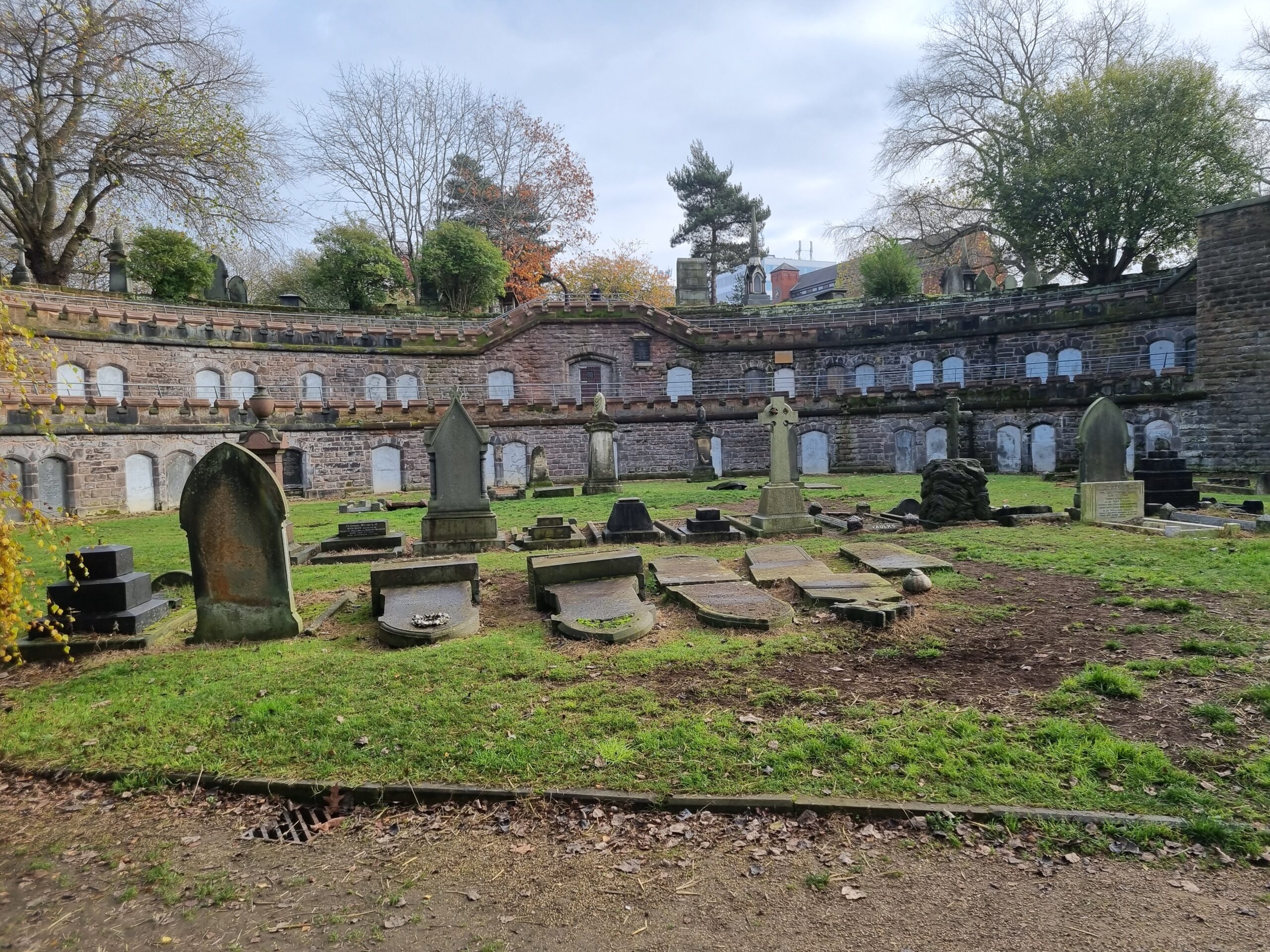
Some tombs which could do with being visited more often: The Birmingham Catacombs – excellent tour available at Birmingham Walking Tours
I am currently reading The End of Everything by M John Harrison, which I will be talking about at greater length in a future post. But one aspect I want to pick up now is how the response of the characters to the disappearance of many of the familiar landmarks post apocalypse is to lose their cognitive bearings. Thoughts come and go, often not joined up. They struggle to understand what other people are saying to them.
I think this is a much under-explored aspect of a period of change. Our ability to think about what is going on, to plan, to anticipate is affected. Many of us experienced this during the pandemic. Psychology as a discipline changed significantly as a result of World War 2.
This is also an aspect that speculative narratives like this one often miss. Told from the vantage point of 2100, it has humanity in despair in 2046:
I imagine that today’s world must have seemed like an impossible dream in 2046, when my parents were born in Charleston. Then, an estimated 60 million people had just died in the Great Hunger. The world had warmed by 2 °C, relative to its average temperature in the late 19th century. Ecosystems were collapsing, led by coral reefs.
Instead there is a scenario of an international climate agreement (“The Geneva Climate Compact”), followed by accelerated climate breakdown leading to emergency geoengineering (mostly solar radiation management) which stops global warming by 2080.
International agreements, emergency sessions of the United Nations (even the idea that such a session in 2047 would be the first such session since the pandemic!) and even the European Union is still present and correct in this otherwise devastated landscape. The problem with these sorts of projections is that everything the projector is not looking at (in this case everything except average global temperatures and their direct impacts) is assumed unchanged. Many climate models do the same thing. Indeed a perfectly valid use of climate models is to change one variable and keep everything else the same to try and measure the impact of that variable.
However to really think about the future you need to look to your novelists. Kim Stanley Robinson’s New York2140 is a case in point. In it global sea levels have risen by 50 feet. Everyone lives in tower blocks connected by sky bridges which occasionally topple into the canals which were once streets.
I used to think that money markets would not survive events like this, but Robinson posits what I now believe is a more likely future scenario. The Intertidal Property Pricing Index is developed instead, carefully constructed to be reasonably stable despite the instability of the actual real estate being valued, and people bet on it. And soon everyone is fixated on what this index is saying daily rather than the buildings collapsing around them. This is exactly what our finance sector will do of course. There will be money to be made out of such activities after all. And so expectations that they will, in any way, be a leader out of the climate emergency are, in my view, unrealistic.
But also is the idea that our institutions as currently constructed will lead us out of catastrophe, or that a top down maintenance of international institutions will be a dominant feature of a post-apocalyptic world. Any plans we have for the future must be robust against the possible loss of central authority.
This does not lead us towards survivalist prepping, holing up in some remote area with canned foods, bottled water and armaments. As Alex Steffen teaches in his “ruggedization” classes:
I would put to you that if you find yourself in a situation where you’re having to let off some rounds to protect your canned goods, you’ve already failed, you have not understood the assignment.
It means the opposite. Remember another thing about the pandemic: people rose to the occasion, just as politicians sunk to it. People checked on the elderly in their neighbourhoods. In Birmingham for instance:
Within weeks of the crisis unfolding, near on 4,000 mutual aid groups registered on the mutual aid website with an estimated 3 million participants stepping forward to support their neighbours and communities. Widely heralded as the ‘early responders’ to the crisis, these groups – alongside thousands more neighbourhood groups – played a fundamental role in ensuring that local residents received immediate support.
This included “food distribution, errands, shopping and picking up prescriptions for those shielding”.
The truth is we all need each other, we all need back up and connecting with your local community is the most effective way that you can “ruggedize” your life. The characters in Harrison’s book have become isolated from each other.
In Goliath’s Curse, Luke Kemp makes the case that the collapse of the “Goliaths” (large imperial powers which dominate the landscape as now) are often linked with improvements in markers of human flourishing like height, life expectancy and equality. This is because, assuming you can avoid the violence associated with the groups scrabbling for status in the ruins of a collapsed state, the main contributors to that flourishing in the past have been local communities rather than at the state level. He worries that, in our current globalised inter-connected world (Ed Conway’s recent article about The 30,000-mile fish finger is one memorable example) this may not necessarily be our experience the next time. As Kemp says:
It is difficult to see through this fog of uncertainty which groups would fare best post-collapse. For now, being poor in wealth but rich in friends is a better strategy than being a suspicious billionaire under siege in a bunker. Not only that, but cultivating bonds of solidarity and mutual aid rather than ruthless self-interest means that the survivors are more likely to help recreate a world that is worth preserving.
If you want a thought experiment about what happens to the billionaires post-collapse, by the way, I recommend Naomi Alderman’s The Future and Cory Doctorow’s novella The Masque of the Red Death (not that one!). Both dark and hilarious in equal measure.
The future is all of ours to make, but we really need to think about it independently and not necessarily along the tracks that the political class funnel all discussions down. That is a 1% world they are discussing. I will leave the last word to Luke Kemp:
Our greatest achievements are not because of the 1 per cent; they are collective endeavours. As George Eliot once wrote, ‘The growing good of the world is partly dependent on unhistoric acts…half owing to the number who lived faithfully a hidden life, and rest in unvisited tombs.’ It’s time to drop the 1 per cent view and start paying attention to the unmarked tombs and unknown heroes upon whose shoulders we’ve built our world.
Climate campaigners get very irritated with media talking about the “new normal”, pointing out, quite reasonably, that for it to be the new normal would require a degree of climate stability that we have not got, nor have any prospect of getting while we continue to argue about whether net zero (the policy, remember, which is about moving us to a position where we don’t increase the amount of carbon in the atmosphere year after year) is affordable. Poverty and health campaigners got very irritated by the call to “get back to normal” after the pandemic, when it had so clearly demonstrated how our “normal” way of organising society had failed to protect so many of its citizens. As even I could see in March 2020:
My view is that some things that must be different post COVID are already clear. I think as a society we are going to demand more resilience, for example:
Resilience of our health service – this means much higher levels of spending, building deliberate over-capacity into the system in normal times;
Resilience of our food supplies, for example strengthening domestic supply chains;
Resilience of our population, so that we do not have 1.6 million food parcels needing to be given out in a year by the Trussell Trust, in the absence of a pandemic, for instance; and
Resilience of our infrastructure – to everything from floods to banking crises to pandemics to storms and heatwaves.
A picture circulating at the time of a Santiago apartment block with a projection onto it of “No volveremos a la normalidad porque la normalidad era el problema” (we won’t get back to normal because normal was the problem) was actually taken the previous year when the Chilean President had used the word “normality” to justifying lifting the state of emergency, leading to large protests:
But we all have trouble with fast moving situations, or even just moving situations. Remember the media coverage in the early weeks of Covid utterly focused on the number of cases going up each week rather than on the underlying pattern this showed, which had been predicted and could be responded to.
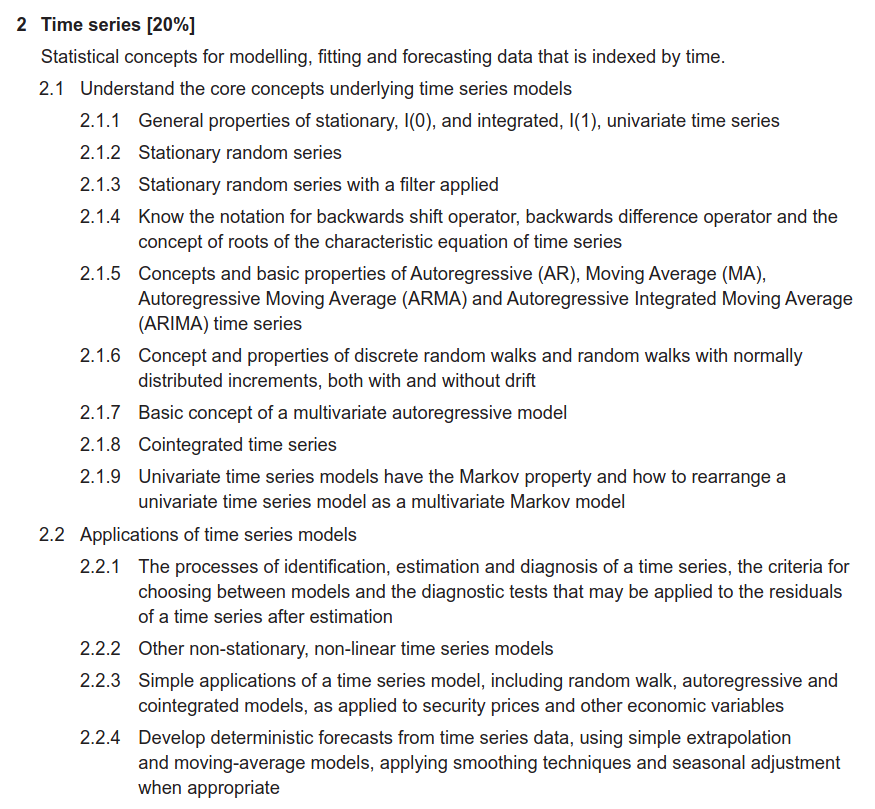
In the Institute and Faculty of Actuaries syllabus, subject CS2 Risk Modelling and Survival Analysis has 20% of its content on dealing with our trouble with moving situations via time series:
It boils down to a number of tricks to turn our moving situation into a non-moving or stationary situation, which we can then analyse.
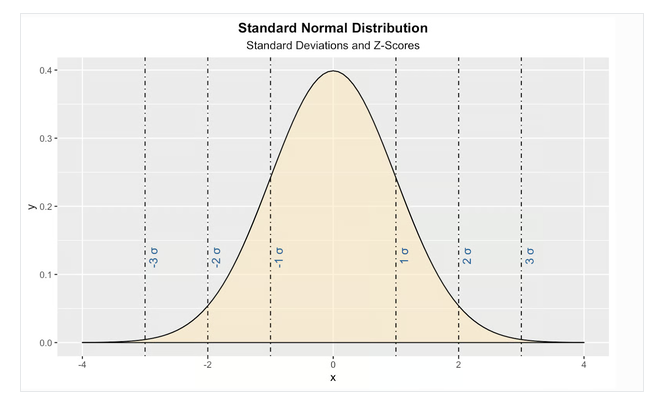
So not being able to deal with things that aren’t stationary is entirely normal. Indeed the Standard Normal Distribution, originally developed in response to a gambler’s query and another thing that we spend a lot of time transforming other distributions into if we can, has a fixed mean of 0 and a fixed variance (a measure of how far things stray from the mean) of 1:
Outside statistical analysis, we use different techniques to make things appear normal. Denial, ie ignoring the departure from normality, is a big one. When this one is no longer tenable in the face of mounting evidence that we are not in Kansas anymore, we often try and depict where we have got to as normal now. This will have been a good strategy in the past: once a natural disaster has passed, taking stock of what has been lost and what remains and working within these new parameters makes more sense than hankering back to how things were before the disaster struck.
However this strategy comes unstuck when one or both of two things are true:
The disaster, or change-event more generally, is not a one-off but a continuing process.
The way we were living before the disaster made the disaster more likely.
So, on climate change, both 1 and 2 are true. On the pandemic, 2 (if you define the disaster as the number of people who died during it, which I do) is clearly also true. And, although it may not be a continuing process, none other than the former Chief Scientific Advisor to the UK Government regards another pandemic as “inevitable”.
We have built systems to look at past disasters and, in particular, try and guard against 2. The Covid Inquiry is working its way through the evidence about the pandemic, and has already produced definitive evidence on how we could do things differently for those who wish to read it, but the reporting of its work is patchy, with sometimes unhelpful fixations on the wrong thing.
And denial tends to fight back as our go-to defence mechanism, which is why we often seem to need to have Public Inquiries about the same things again and again and again.
Triangulation was about the only nearly plausible justification given at school for learning trigonometry. You can estimate the height of that tree without actually climbing the tree and dropping a tape measure, you just need the distance to the tree and the angle the top of the tree makes from where you’re standing.
Triangulation with satnavs (measuring your distance from three satellites) narrows your position down to two points, although the one you’re using probably uses more like 10 to increase accuracy and be robust against rogue measurements.
However, according to Verywellmind.com, triangulation in psychology means:
…a manipulation technique where one person involves a third party in a conflict to gain control or create division. This tactic is common in toxic relationships and among those with certain personality disorders, like narcissism and borderline personality disorder. Recognizing the signs and setting boundaries can help you protect yourself from its harmful effects.
Which is where it enters our political, business and personal lives of course. In politics, former US President Bill Clinton is most closely associated with triangulation. As Nesmith and Quirk have said in their book Inside the Presidency of Bill Clinton:
In this strategy, Clinton would stand firm on partisan Democratic positions when they were popular. On issues where Republican positions were more popular, however, Clinton would take advantage of the current Republican Congress’s tendency to overreach: he would make major concessions from conventional Democratic policies and adopt centrist positions that would have broader support than the Republicans’ offerings. By such systematic, instrumental positioning, Clinton hoped to win politically on most issues, no matter which party had the initial advantage in public opinion.
This approach was then adopted by Tony Blair with New Labour and has become pretty mainstream in politics ever since. Keir Starmer perhaps took it to new extremes with his Ming Vase strategy:
The Ming Vase strategy’s underlying premise was that, at least in matters of high political salience, policy-making should be above all driven by perceived electoral advantage. The metaphor was that Labour should treat its prospects as precarious and fragile, and that the utmost caution and prudence must be exercised in developing policy. As the term is used here, the Ming Vase strategy can be encapsulated in terms of two broad principle, opinion alignment and power accommodation. The former held that on issues which figure prominently on the public’s agenda (which of course excludes policy in many areas) policies must be adapted as closely as possible to voters’ perceptions and preferences as these can be culled from focus groups. The latter stipulated eschewing as far as possible policy options that were likely to antagonise or estrange the major constellations of power in society, those organised interests which had the capacity both to influence mass opinion and to affect the capacity of a government to deliver its policies—most notably the City and major corporations. The two arms of the strategy tended to be mutually reinforcing, in that both emphasised the need for circumspection, the avoidance of controversial and ambitious policies, and an accent on reassurance. We are not claiming that the Ming Vase strategy, as an operational code, was the sole determinant of decision-making behaviour, but rather that it was the weightiest.
And when opinion alignment and power accommodation (ie public opinion and the views of, say, powerful business lobbies) are in conflict? Well you have to pretend to be doing one thing while doing another. And there were a whole succession of examples of Starmer not acting as most of his backbenchers had been led to expect a Labour prime minister to act and putting it down to the fiscal rules they were operating under until Andy Burnham finally put him out of his misery. But the fiscal rules have remained.
These sorts of strategies ultimately tend to come unstuck because they underestimate the voters. Most people understand that our problems aren’t easy to solve, but if you make grand pronouncements about transforming politics while constraining your room for manoeuvre within fiscal rules set to appease particular interests which you don’t come clean about, then ultimately you will be regarded as untrustworthy. As you will also fail if you pin all of societies ills on desperate people taking their lives in their hands on small boats in the English Channel, and then find that none of those problems have disappeared but you now also have something resembling Trump’s Immigration and Customs Enforcement (ICE) patrolling the seas.
The Grand High Triangle Lover from Sesame Street is always accompanied by Norman, who bangs a triangle to get the crowd’s attention for his boss. Think of Norman as a lobby journalist. The Grand High Triangle Lover likes to tell the story of how he became The Grand High Triangle Lover by managing to pull sticks from a stone and making them into a triangle. However Norman broke the big scoop that in fact his boss just found a hat with triangles on it one day.
It sounds like a normal day in our politics, but these are muppets. Recognise the signs and set boundaries. Let’s not let them assume the rest of us are.